Written by the Stylfixx team · Reviewed by Omar Sharieff, Director, Stylfixx Innovations Pvt. Ltd. · Last updated 13 November 2026
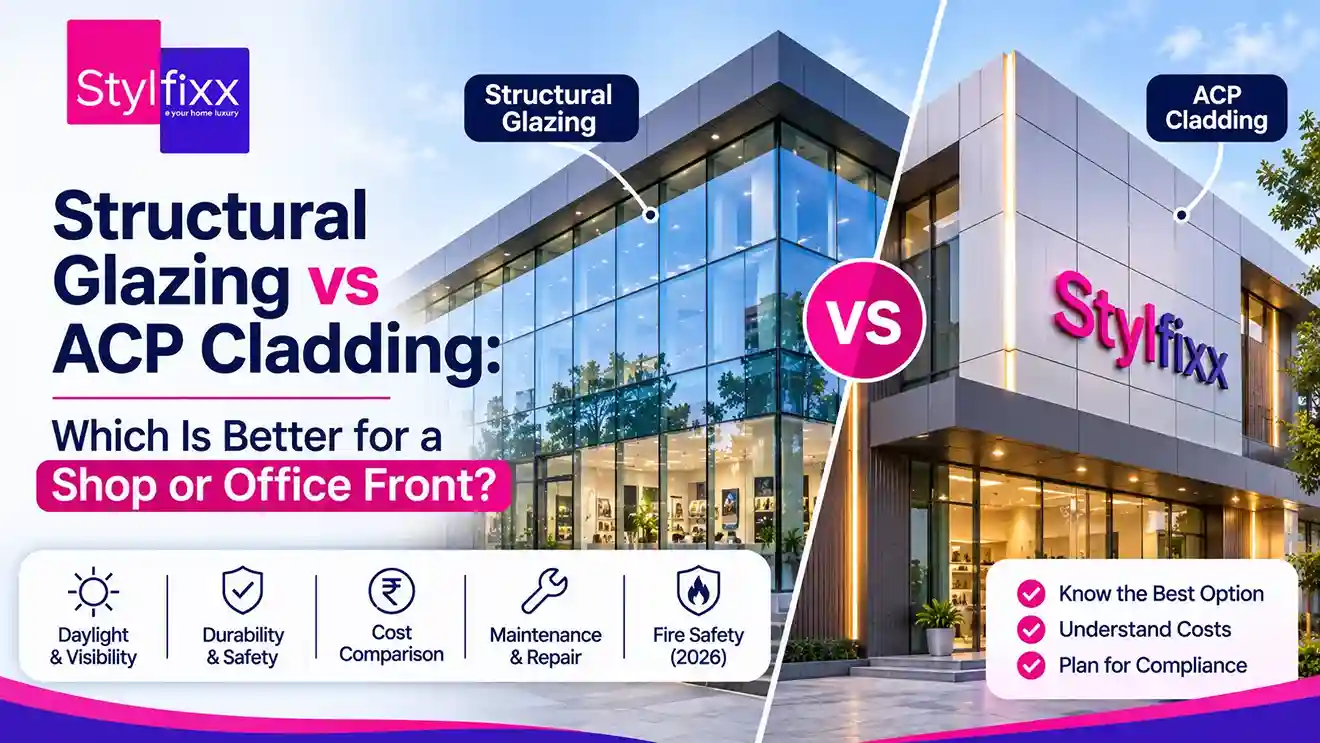
Quick answer: choose structural glazing when people need to see in, as in showrooms, cafés and car or jewellery stores. Choose ACP cladding when you need signage space, want to hide columns, AC units and wiring, or have a tighter budget. In Bangalore, ACP cladding typically costs ₹250–₹600 per sq ft installed, depending on core and coating. Structural or facade glazing typically costs ₹450–₹900 per sq ft. Many good shop and office fronts use both: glass at street level and ACP above it for the sign band.
What each one is
Structural glazing is a glass facade where the glass panels are bonded to an aluminium frame with structural silicone, so the outside looks like a continuous sheet of glass with little or no visible frame. It is used for showroom fronts, office facades and entrances. Our guide on glass glazing work covers railings, partitions and facades.
ACP cladding uses aluminium composite panels, two thin aluminium sheets bonded to a core, fixed on an aluminium or steel frame over the wall. Panels come in solid colours, metallic, wood and stone finishes, and are cut and grooved into designs. See ACP cladding for panel types and prices.
Structural glazing vs ACP cladding: side by side
| Structural glazing | ACP cladding | |
|---|---|---|
| Typical installed cost in Bangalore | ₹450 – ₹900 per sq ft | ₹250 – ₹400 per sq ft (standard core); ₹380 – ₹600 (fire-retardant core); ₹350 – ₹700 for designed shop fronts |
| What customers see | The inside of the shop and the product | A solid branded surface with signage |
| Daylight | Plenty, which can mean glare and heat | None through the panels |
| Heat gain | High on west- and south-facing fronts unless you use performance or double-glazed glass | Low; the panel shades the wall behind |
| Hides services | No; AC units and wiring behind are visible | Yes; covers columns, AC outdoor units, pipes and old walls |
| Signage | Vinyl or frosting on glass, or a separate sign band | Letters and logos fixed directly; lit signs easy to mount |
| Cleaning | Regular glass cleaning to look good, more often on dusty roads | Occasional washing; the coating resists dirt |
| Damage and repair | A broken pane needs a new pane cut to size | A dented panel can be replaced on its own |
| Fire | Toughened glass is non-combustible; frames and sealants are the weak points | Depends on the core; fire-retardant (FR) or A2 cores are recommended for commercial fronts |
Which suits your building?
| Building | What usually works |
|---|---|
| Showroom (cars, furniture, jewellery, fashion) | Structural glazing at street level; ACP sign band above |
| Café or restaurant | Glazing at the front for visibility, ACP on side walls and the sign band |
| Shop on a busy market street | ACP front with a glass door and display window, to keep costs down and hide AC units |
| Clinic, bank or office | ACP or a mix; glass for the entrance and reception |
| Office building facade | Glazing for daylight in workspaces, ACP to cover slab edges, columns and services |
| House front elevation | ACP or HPL feature panels; glass only at balconies and windows. See ACP vs HPL cladding |
Fire safety: what to check in 2026
- Panel core. Standard ACP has a plastic core that can burn. For shops, offices and any building where people gather, choose a fire-retardant (FR) core, or an A2 mineral core for taller buildings, and ask for the fire test certificate for the exact panel.
- BIS certification. Aluminium composite panels are covered by the Aluminium and Aluminium Alloy Products Quality Control Order 2026, which requires panels sold in India to carry the BIS mark. Check that the panels delivered carry it.
- Building rules. The National Building Code 2016 was replaced in April 2026 by the National Building Construction Standards 2026 (SP 7:2026), which frame most fire provisions as recommendations. Fire NOC rules, height limits and local approvals are still set by the state and the local authority. For a taller or larger commercial building in Bengaluru, ask your architect or fire consultant what the fire NOC requires before choosing the facade.
- Glass. Use toughened glass for glazing, and laminated or toughened-laminated glass where breakage could fall on people below.
Bangalore conditions to think about
- Sun and heat: west-facing glass shopfronts get hot in the afternoon, which raises AC load. Performance glass, double-glazed units or an ACP canopy above the glass helps.
- Dust: fronts on busy roads need frequent glass cleaning. ACP shows dust less.
- Monsoon: both systems depend on good sealant joints and drainage. Ask how water is kept out at the top and the base of the facade.
What to ask for in a facade quote
- Drawings or an elevation showing panel and glass layout.
- ACP: panel thickness (usually 4 mm for exteriors), core type (standard, FR or A2), coating (PVDF for exteriors), brand and BIS mark.
- Glass: thickness, toughened or laminated, clear or performance glass, and hardware or frame details.
- Frame material and size, and how it is anchored to the building.
- Sealant brand and type, and how joints are waterproofed.
- Signage cut-outs, lighting points and access for cleaning.
- Timeline, payment stages, GST and warranty.
For billing and tax codes, see our guide to GST, HSN and SAC codes for glazing and ACP work.
How Stylfixx helps
Stylfixx designs and installs ACP cladding, structural glazing, shopfront glass and glass partitions across Bengaluru, often combined on the same front. We check the existing wall, measure on site and give you an elevation and an itemised quote for both options so you can compare them. See ACP cladding and glass glazing.
Get a facade quote: call or WhatsApp +91 98861 66157 with a photo of your building front, or use our contact form. Open Monday to Saturday, 9 am to 6 pm.
Sources: Aluminium QCO 2026 summary (IndiaLaw) · SP 7:2026 replaces NBC 2016 (Agile Regulatory) · NBCS 2026 fire provisions (The Aarch News)
FAQs
Which is cheaper, ACP cladding or structural glazing?
ACP cladding is usually cheaper. In Bangalore it typically costs ₹250 to ₹600 per sq ft installed, depending on core and coating, compared with ₹450 to ₹900 per sq ft for structural or facade glazing.
Can I combine glass and ACP on the same front?
Yes, and it is common: glass at street level for visibility and the entrance, with ACP above for the sign band and to cover columns and AC units.
Is fire-rated ACP required for a shop front?
Fire rules for each building are set by the state, the local authority and the fire NOC conditions. For shops and offices, a fire-retardant (FR) core with a test certificate is the safer choice, and taller buildings may need non-combustible A2 panels.
Does a glass front make a shop hotter?
Yes, especially on west- and south-facing fronts. Performance glass, double-glazed units or a canopy above the glass reduce the heat gain.
Which ACP thickness is used for exterior shop fronts?
Exterior cladding normally uses 4 mm panels with a PVDF coating, which holds its colour outdoors. 3 mm panels with a polyester coating are used for interior wall panelling.
Planning Your Project?
Get expert guidance on design, materials, and cost planning from the Stylfixx team.