Written by the Stylfixx team · Reviewed by Omar Sharieff, Director, Stylfixx Innovations Pvt. Ltd. · Last updated 5 November 2026
Quick answer: For an exposed terrace with cracks or movement, a polyurethane (PU) coating is usually the best waterproofing. It typically lasts 10 to 15 years and costs the least per year of protection. An acrylic elastomeric coating suits terraces in fair condition on a tighter budget. APP or SBS membranes suit large flat roofs that will be covered with tiles or screed. Cementitious coatings are cheapest but belong under tiles, in sunken areas and sumps, not out in the sun.
That is the short version. Which method is right for your roof depends on whether it is exposed or tiled, how cracked it is, how it is used and how long you plan to stay. This guide compares the four main methods on cost and life, shows which one fits which kind of terrace, and explains the preparation work that decides whether any of them actually stops a leak.
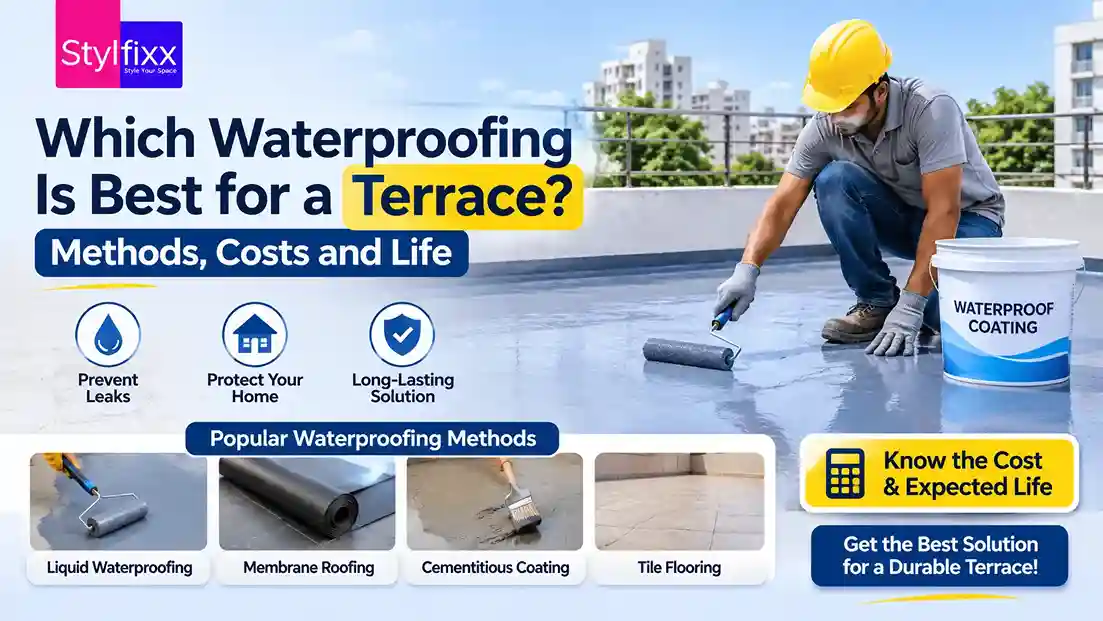
Terrace waterproofing methods compared
Rates below are typical 2026 Bengaluru market rates per sq ft, including surface preparation, material and labour. Your exact price depends on the terrace's condition and is fixed after an inspection.
| Method | Cost per sq ft | Typical life | Handles cracks and movement | Sun (UV) exposure | Foot traffic | Best for |
|---|---|---|---|---|---|---|
| Cementitious coating | ₹35 – ₹60 | 3–5 years | Poor (rigid) | Poor unless covered | Fair | Under tiles, sunken areas, sumps, tight budgets |
| Acrylic elastomeric coating | ₹50 – ₹90 | 5–8 years | Good (hairline cracks) | Good | Light | Exposed terraces in fair condition |
| Polyurethane (PU) coating | ₹80 – ₹150 | 10–15 years | Very good | Good with a UV-stable top coat | Good | Exposed terraces with many cracks or movement |
| APP or SBS membrane | ₹80 – ₹160 | 6–10 years | Good | Fair; best covered | Needs a protective layer | Large flat roofs, under tiles or screed |
Lifespans are typical ranges for a correctly prepared and applied system. A poorly prepared surface can fail in a single monsoon, whatever the product.
Which method suits your terrace?
Match your situation to the row that describes it:
| Your terrace | Best fit | Why |
|---|---|---|
| Exposed concrete, several cracks, leaks into the top floor | PU coating | Stretches with the slab and bridges cracks, and lasts longest exposed to sun |
| Exposed, few hairline cracks, no active leak | Acrylic elastomeric coating | Flexible, reflects heat, costs less than PU |
| New RCC slab that will be tiled | Cementitious coating or membrane under the tiles | Tiles protect the layer from sun; rigid systems work well when covered |
| Old tiled terrace that now leaks | Lift the tiles, waterproof, re-tile (see below) | A coating on top of failed tiles rarely lasts |
| Large flat roof on a villa, office or apartment block | APP or SBS membrane with a protective screed, or PU | Membranes cover big areas quickly with uniform thickness |
| Terrace garden or planters | Root-resistant membrane plus a drainage layer | Roots and constant moisture defeat ordinary coatings |
| Renting out or selling within 2–3 years | Acrylic elastomeric coating | Lower upfront cost for the time you need |
If your terrace fits two rows, the more demanding one wins. A cracked slab that will also carry a garden needs the garden solution.
The four main terrace waterproofing methods
Cementitious coating
A cement-based slurry, usually mixed with an acrylic polymer, brushed on in two coats. It is cheap, easy to apply and bonds well to concrete. Its weakness is rigidity: when a sun-heated slab expands and cools, the coating cracks with it. Use it where it will be covered, such as under tiles, in bathrooms and in sumps, rather than as the final surface of an open terrace.
Acrylic elastomeric coating
A rubbery liquid coating, usually white, applied in two or three coats with fabric at corners and joints. It stretches over hairline cracks and reflects much of the sun's heat, which can make the room below noticeably cooler. Most "terrace waterproofing paint" sold by paint brands is this type. It needs recoating sooner than PU and wears faster where people walk often.
Polyurethane (PU) coating
A liquid-applied system that cures into a seamless, highly flexible membrane. It handles cracks and slab movement better than anything else applied as a liquid, tolerates ponding water well, and with a UV-stable top coat it lasts longest on an exposed roof. It costs more and needs a dry, well-prepared surface and careful application, so the installer's skill matters as much as the product.
APP or SBS bituminous membrane
Factory-made sheets that are torch-applied or self-adhered with overlapping joints. They give a uniform thickness over large areas, which is why they are common on big commercial roofs. They are usually covered with screed or tiles, because sun and foot traffic shorten their life. The overlaps and edges are the weak points and need careful sealing.
Older Bengaluru houses may have traditional brickbat coba or lime terracing. These work by thickness and slope rather than as a membrane, and once they crack they are usually repaired and then coated, or removed if they are hollow.
What does it cost to waterproof a terrace?
For a 1,000 sq ft terrace in Bengaluru, typical 2026 prices are:
- Cementitious: about ₹35,000 to ₹60,000
- Acrylic elastomeric: about ₹50,000 to ₹90,000
- PU coating: about ₹80,000 to ₹1,50,000
- APP or SBS membrane: about ₹80,000 to ₹1,60,000, plus the protective screed or tiles
The upfront price misleads, because the cheaper systems need redoing more often. Dividing the mid-point price by the mid-point life gives the cost of each year of protection:
| Method | Mid-point cost per sq ft | Mid-point life | Cost per sq ft per year | 1,000 sq ft over 15 years |
|---|---|---|---|---|
| Cementitious (exposed) | ₹47.5 | 4 years | about ₹12 | about ₹1.8 lakh |
| Acrylic elastomeric | ₹70 | 6.5 years | about ₹11 | about ₹1.6 lakh |
| PU coating | ₹115 | 12.5 years | about ₹9 | about ₹1.4 lakh |
Over 15 years, a PU system usually works out cheaper than repeating a cheaper coating three or four times, and it means fewer leaking monsoons and less repainting of ceilings. The calculation leaves out price rises and the cost of damage between failures, both of which favour the longer-lasting option. Membranes are not in the table because their life depends heavily on the covering laid over them.
What pushes the price up: many cracks, hollow or loose old coba, fixing the slope, extra outlets, removing old tiles, and access for materials on taller buildings.
Preparation matters more than the product
A terrace usually leaks because of how the waterproofing was applied, not which brand was used. A sound job includes:
- Drainage first. Water must run off. The terrace needs a visible fall towards the outlets (contractors commonly aim for about 1 in 100, or 1 cm per metre), with no low spots where water stands for more than a few hours after rain.
- Clear, enough outlets. Blocked or too few rainwater pipes cause ponding, and ponding water finds every weakness.
- Crack repair. Cracks are opened, cleaned and filled with a flexible sealant or polymer mortar before any coating goes on.
- A clean, dry surface. Dust, algae, loose plaster and peeling old coating are removed, and the slab is allowed to dry. Coatings on damp concrete blister and peel.
- Cove at the parapet. The sharp joint between the floor and the parapet wall is rounded with a mortar fillet and the waterproofing is turned up the wall, usually by 150 to 300 mm. This joint is where most terraces leak.
- Fabric at weak points. Corners, joints, outlets and pipe penetrations get a reinforcing fabric embedded in the coating.
- Right thickness. The coating goes on in the number of coats the manufacturer specifies, usually at right angles to each other, without thinning it to stretch the material.
- Flood test. The finished terrace is flooded with a few centimetres of water for 48 hours while the ceiling below is checked for damp.
If a quote does not mention slope, the parapet joint or a flood test, ask about them.
Do tiles waterproof a terrace?
No. Tiles are a wearing surface, not a waterproof layer. Water gets through grout joints and cracked tiles and travels underneath, so a tiled terrace can leak far from where the water enters. You have three options:
- Clear coating over the tiles: a transparent waterproof coating and re-grouting. It is cheap and quick, but usually a short-term fix of a few years.
- Coating over the tiles: some PU and elastomeric systems can go over sound, well-bonded tiles after the glaze is roughened. This is only worth doing if very few tiles are hollow.
- Lift, waterproof and re-tile: the lasting fix for a terrace that already leaks. The tiles and bedding come off, the slab is repaired and waterproofed, and new tiles are laid on top with flexible adhesive. Our tile installation team handles the re-tiling.
Terrace gardens need a different system
Soil and planters keep the slab wet all the time, and roots force their way into joints. A terrace garden needs a root-resistant membrane, a drainage board or layer so water does not sit under the soil, and a protection layer before the soil goes in. Waterproof the slab before you build the garden; fixing it later means moving every planter. Free-standing pots raised off the floor need no special system, as long as the terrace below them drains.
When to waterproof a terrace in Bengaluru
Bengaluru gets two monsoons: the southwest monsoon from about June to September and the northeast monsoon from about October to November. Waterproofing needs a dry slab and dry days for curing, so the best window is December to May. Book an inspection in January or February, finish the work by April, and you go into June with a tested terrace. Work can be done in breaks between monsoon showers, but only once the slab has dried out, which a moisture meter can confirm.
Common mistakes to avoid
- Coating a wet slab. Trapped moisture lifts the coating within weeks.
- Ignoring the drainage. No coating survives water that stands on it for days.
- One thin coat. Material stretched to cover more area gives less than the stated life.
- Skipping the parapet joint. The floor stays dry and the wall junction leaks.
- Using a rigid cement coating on an exposed roof. It cracks with the first hot season.
- Repainting the ceiling before fixing the terrace. The stain comes back after the next rain. Our painting and waterproofing team fixes the leak first, then repaints.
Questions to ask a waterproofing contractor
- Which system and product will you use, and how many coats?
- What surface preparation is included: crack filling, removing old coating, fixing the slope?
- How will you treat the parapet joint, outlets and pipe penetrations?
- Will you flood-test the terrace before handover?
- What does the written warranty cover, for how long, and what would void it?
An honest contractor answers all five in writing. Comparing two quotes on these points tells you more than comparing their prices.
How Stylfixx waterproofs terraces
Stylfixx waterproofs terraces, bathrooms and sumps across Bengaluru, from Hennur, Kalyan Nagar and HRBR Layout to Hebbal, Thanisandra and Frazer Town. We check the slab and the ceiling below with a moisture meter, trace where the water enters, and recommend the system that fits your terrace, not the most expensive one. We fix slope and outlets, repair cracks, form the parapet cove, apply the system in full coats and flood-test it for 48 hours. Warranty terms are written into your quote. Leaks often come with structural cracks; our civil works team repairs those, and damp patches inside are handled with bathroom renovation where the source is a bathroom above.
Book a free terrace inspection: call or WhatsApp +91 98861 66157 with photos of the terrace and the ceiling below. Open Monday to Saturday, 9 am to 6 pm.
FAQs
Is Dr. Fixit or Asian Paints better for terrace waterproofing?
Both, along with Fosroc, Nerolac, Berger and others, sell cementitious, elastomeric and PU terrace products. The type of system and the quality of preparation matter far more than the brand. Compare like with like: a PU coating from one brand against a PU coating from another, not a PU coating against a cement coating.
Can terrace waterproofing be done during the monsoon?
Only on dry days and only once the slab has dried, which can take several days after heavy rain. Liquid coatings need dry weather while they cure. If a leak is urgent in the monsoon, a temporary repair can wait for a full job in the dry season.
Does a new terrace need waterproofing?
Yes. Concrete is not waterproof; it develops shrinkage cracks as it cures, and the slab moves with heat. Waterproofing a new slab once it has cured is cheaper than repairing a leak and the ceiling below later.
Does terrace waterproofing reduce heat in the room below?
White reflective elastomeric and PU top coats reflect much of the sun's heat, so the top-floor room usually feels cooler in summer. The exact difference depends on the product, insulation and ventilation.
Can I walk on a waterproofed terrace?
Yes, after the coating has fully cured, usually within a few days to a week depending on the product. PU coatings handle regular foot traffic best. For heavy use, such as a terrace used for gatherings or drying clothes daily, a protective top coat or tiles over the membrane last longer.
Can I waterproof a terrace myself?
You can apply a coating on a small terrace in good condition, but most failures come from the preparation: slope, cracks, the parapet joint and coat thickness. For a terrace that already leaks into a room, a professional inspection costs little compared with doing the job twice.
Planning Your Project?
Get expert guidance on design, materials, and cost planning from the Stylfixx team.